
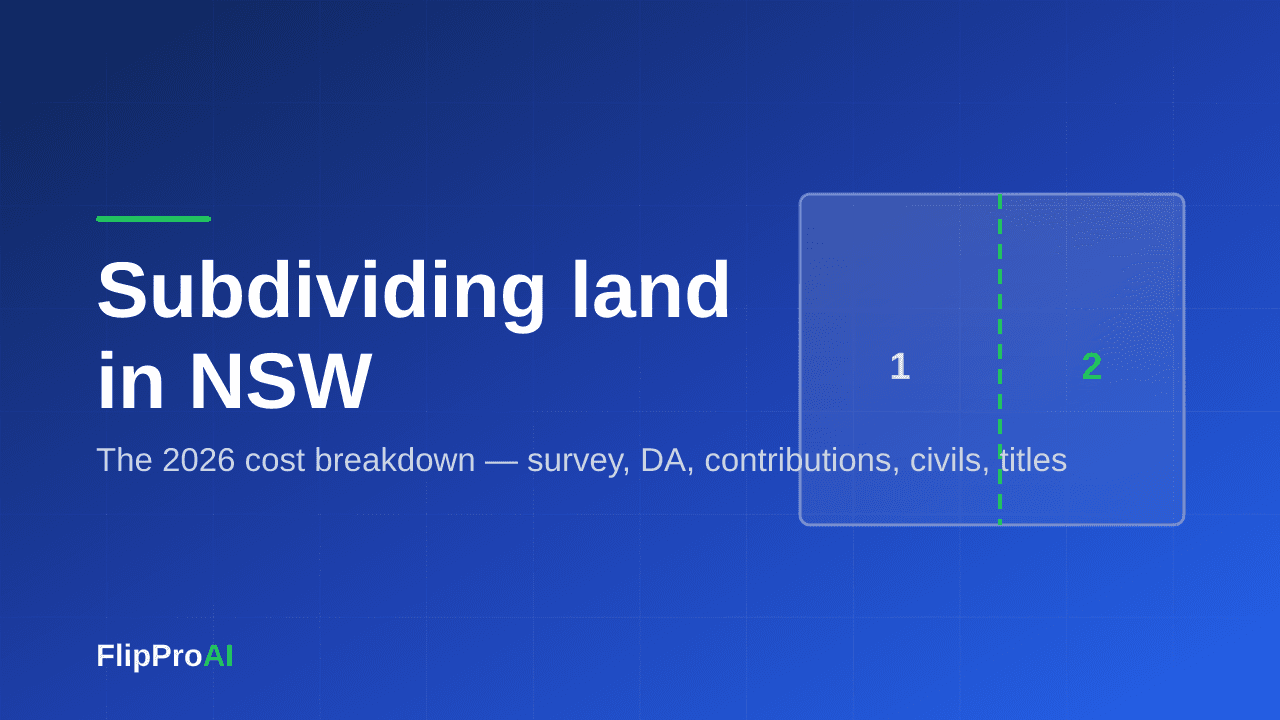
How much does it cost to subdivide land in NSW?
By Nicholas Gee··7 min read
The honest answer to how much it costs to subdivide land in NSW is a range, not a number, and the range is wide: a basic two-lot Torrens subdivision in an outer-Sydney or regional suburb typically lands somewhere around $45,000 to $60,000, with complex sites pushing past $100,000. That spread is not vagueness for its own sake. It reflects the fact that half the cost is professional fees and government charges you can estimate up front, and the other half is civil works you genuinely cannot price until a surveyor and an engineer have looked at the dirt.
So the useful thing is not a headline figure. It is understanding the cost stack, knowing which lines are fixed and which are the wildcards, and being able to test whether the whole exercise still leaves a margin once you add it all up. This is general information rather than planning or financial advice, but it will tell you what to budget for and where the money actually goes.
What it costs to subdivide land in NSW: the cost stack
A subdivision budget breaks into five buckets. Get a real quote on the first two, treat the middle one as a lookup, and hold your breath on the last two until the site is investigated.
Survey and plan preparation. Only a registered surveyor can prepare the plan of subdivision that gets lodged and registered, and they also set out the new boundaries on the ground. Subdivision surveys typically start from around $3,500 for a straightforward two-lot job and climb with the number of lots, the site's slope and how much existing detail has to be picked up. This is one of the more predictable lines.
Town planning and the DA. Most subdivisions go through a development application to council, which usually means a town planner preparing the application and council charging a lodgement fee. DA fees in NSW are set by regulation and scale with the value of the work, so for a small residential subdivision they are commonly in the hundreds to low thousands of dollars, on top of the planner's fee. Some straightforward subdivisions can go through the complying-development pathway instead, but for a splitter block a merit-assessed DA is the common route.
Developer contributions (section 7.11 / 7.12). This is the line people forget, and it can be the biggest. Under the Environmental Planning and Assessment Act, councils levy contributions toward local infrastructure — roads, drainage, parks, community facilities — when you create new lots. These are the section 7.11 and 7.12 contributions, and they are charged per additional lot, so splitting one block into two is generally levied on the one new lot you have created. The amount is set by each council's contributions plan and varies enormously by area. There is a ceiling worth knowing: a plan that wants to charge more than $20,000 per lot (or $30,000 in designated greenfield and urban-release areas) has to be reviewed by IPART before council can impose it, which is a rough guide to the top of the range in an established suburb. Check the specific council's contributions plan for your site rather than assuming.
Civil works. This is the true wildcard, and the reason two apparently similar blocks can cost tens of thousands of dollars apart. Each new lot generally needs its own connection to the water main and its own sewer connection, and Sydney Water connection requirements are among the most variable costs in any subdivision. Add stormwater drainage, any earthworks or retaining, a driveway or crossover, and power and telecommunications to the new lot, and the civils bill can quietly dwarf the survey and DA combined. Until someone investigates the services, you are guessing.
Compliance, titles and registration. At the back end there are certification and plan-sealing fees, and the cost of registering the new plan and issuing separate titles through NSW Land Registry Services, plus the conveyancing to close it out. Individually small next to the civils, but they are real and they come at the end when the budget is already tired.
The timeline reality
Money is only half the picture, because a subdivision ties up cash for a long time. In most NSW councils the process runs 12 to 18 months from lodging the DA to registered titles, and it is not a smooth line: you wait on council assessment, then on construction certificates, then on the civil works themselves, then on the subdivision certificate and finally on registration at the Land Registry. Contributions are typically payable at the subdivision-certificate stage, near the end, which at least means you are not funding them on day one, but the interest, rates and insurance on the land run the entire time.
For a flipper that holding period is the hidden cost that never shows up on the surveyor's quote. Every month the project runs is another month of holding costs against a block that is not earning, so a subdivision that pencils on paper at today's costs can still disappoint if it drags a year longer than you modelled.
What makes the costs blow out
The blowouts are almost always in the civils and the approvals, not the survey.
The big ones: a site that needs a long or deep service run to reach a water or sewer main; significant fall across the block that forces retaining walls and cut-and-fill; a sewer main or easement running through the land that dictates where you can build; and trees or overland flow paths that eat the developable area. Overlays do the same damage as they do on any deal — flood, bushfire and heritage constraints can add engineering, reports and conditions, or push the design around until the numbers no longer work. This is the same overlay homework that decides a build, and it is worth reading how to read a council LEP and its overlays before you fall for a block.
The other quiet blowout is GST. Subdividing and selling can tip you into being an enterprise for GST purposes, and the GST margin scheme is often how the tax on the sale is worked out. That is a conversation to have with your accountant before you buy, not after you sell, because it changes the net figure the whole deal turns on.
Does it pencil? Run the feasibility
Here is the thing about subdivision costs: the total only matters relative to the uplift. Splitting a block is worth doing when the two finished lots (or the two houses you build on them) are worth meaningfully more than the single site plus every cost above plus a margin for the risk and the 12-to-18-month wait. When the numbers are tight, the civils wildcard is usually what decides it, which is exactly why you want the cost stack modelled before you exchange, not after.
That is the calculation to run properly rather than in your head. I have written separately about when a subdivision actually pencils and walked through the maths of comparing the split against a straight renovation. Our feasibility tool lets you test a subdivision against the other strategies on the same address — hold, cosmetic flip, granny flat, splitter — so you are comparing real figures side by side (and if you are weighing a build rather than a bare-land split, what it costs to build a duplex in NSW runs that play, while a specific granny flat vs subdivision call is weighed directly in that post), and a full analysis pulls the zoning, the overlays and the flip strategies together before you make an offer. If the split does not clearly beat the simpler play once all these costs are in, the simpler play usually wins. And if your block is over the border, the numbers and the process differ — what it costs to subdivide land in QLD walks through the reconfiguring-a-lot pathway, and what it costs to subdivide land in VIC covers the certification-and-statement-of-compliance route plus the public open space levy.
Subdivision rewards the boring homework. Price the survey and the DA, look up the council's contributions plan, get the services investigated early so the civils stop being a mystery, and hold the whole cost stack against a realistic resale. Do that and the split becomes a clean line in your feasibility instead of a five-figure surprise. If you are new to running these numbers, the complete guide to flipping a house in Australia puts the subdivision decision in the context of the deal as a whole.
This is general information only and not planning, financial, tax or legal advice. Subdivision costs, council contributions plans and GST treatment change and vary by site and jurisdiction. Figures here are indicative ranges from industry sources current at the time of writing. Always get quotes from a registered surveyor and civil engineer and confirm the current council and Land Registry charges for your specific block before you commit.
Written by
Nicholas Gee
Founder of FlipPro AI. A 30-year IT director and hands-on Australian property renovator, flipper and small developer, Nicholas built FlipPro out of the feasibility spreadsheets he ran on his own deals.
More about Nicholas →Related reading
How much does it cost to subdivide land in WA?
What it costs to subdivide land in WA in 2026: surveyor and WAPC fees, Water Corp and Western Power headworks, the 10% open space rule, and the blowouts.
Read post →How much does it cost to subdivide land in SA?
What it really costs to subdivide land in SA in 2026: surveyor and Land Services SA fees, the open space contribution, SA Water, civils and the blowouts.
Read post →How much does it cost to subdivide land in VIC?
What it really costs to subdivide land in VIC in 2026: surveyor, planning permit, the public open space levy, civils, and the blowouts to plan for.
Read post →Want this whole calculation done in three minutes?
Open the FlipPro workspace, paste the listing and carry the result into feasibility, budgets and a live project.
Free to search and browse. Eligible new Pro and Elite customers see the 7-day trial in checkout.